We get how rough paperwork & many apps are on field techs.
Your crew texts or talks their way through the job — a checklist, a technical sentence, a long voice note, or hands-free in a Bluetooth earpiece with the phone still in their pocket. The readings, the photos, the signature, the parts used: captured on site, validated as they go, and back in your system before the truck leaves the driveway.
Let’s talk about getting paid
You did the work. The truck went out, the part went in, the customer is happy. Then the invoice sits. Miss one filter picture and it is held up. Use the same photo for the before and the after — and somebody notices — and it is suspended. Terms of 90 to 120 days can be normal before anything even goes wrong. Every rejection is more float on work you have already paid a tech for.
And every program wants it differently. Different photo counts, different fields, different sign-off — then the end customer underneath wants something else again. Nobody in your office can hold all of it, so your techs are asked to, at the end of a long day, from memory. The photo nobody took surfaces six weeks later, in a dispute.
The way out is not another rigid app. It is one system that is deliberately not your source of truth — that cherry-picks only the data a task needs, lets people line it back up the way their business actually works, enriches it in the field, and hands it back. Adaptive per customer, per job, per season, because the conversation is designed rather than compiled.
We get you the proof, and we untangle the requirements. So you get paid.
The way out
A work order is never just a work order. It belongs to this customer, at this site, on this asset, under this program — each of which wants something different at close-out. Four photos and a gate code here. A different sign-off there. An extra reading for the account that asked for one last spring.
So the workflow assembles itself from that context before the tech ever opens it. They are never handed a menu of checklists to pick the right one from. They are never told to remember a rule. The steps that appear are the steps that job owes, and the job will not close until they are done.
The national's requirements and the end site's requirements both apply, and neither the dispatcher nor the tech has to know which is which.
This RTU, this panel, this backflow device — with last visit's readings alongside, so out-of-tolerance is caught while somebody is still standing there.
Certifications, language, what they are allowed to sign off. The same job reaches a W-2 crew and a one-day sub correctly.
All the tech has to do is the work, and answer as they go. The rules were somebody else's problem before they got in the truck.
Job-aware checklists your field will love
Every crew already runs a checklist. On paper, in a portal, or in somebody’s head. The trouble is it is the same checklist for every customer, it takes twenty minutes nobody has, and half of it gets filled in from memory at the end of the day — which is exactly when the photo that would have settled a dispute does not get taken.
A dynamic field checklist is built for the job in front of them. It asks for what this customer requires, in whatever order the site allows, and it will not close until it has what you need — the readings, the photos, the serial, the quote, the signature. Not a form that can be skipped past. Proof, captured while the truck is still there.
The steps come from the job’s customer, site and asset. No menu of forms, no rule to remember, no wrong version from last year.
Tap through it, type a line, send a long voice note, or go hands-free with the phone in a pocket. Whatever is possible with the hands they have free.
A photo they could not take yet is tracked as owed, not forgotten. The job stays open until every one is cleared.
And it can be accelerated. Instead of answering twenty questions, a tech can describe the job in one go — a paragraph, or a voice note on the drive to the next call — and Wingman, our conversational engine, maps what they said onto the checklist and fills a dozen steps at once. Each one still goes through the same validation a tapped answer would. Twenty minutes becomes two, and nothing is lost.
Nobody has to be chatty, either. Prefer to tap? Take it step by step. One checklist, two speeds, identical proof out of either. The rigidity is on the data, never on the person.
Bottom line: you get proof. Every job, the same shape, whether they talked it or tapped it.
Your crew, in their own words
Half the trades in this country run on crews who think in Spanish, and every system they touch makes them work in English. So the notes get short, the detail gets lost, and the office blames the tech for paperwork the software made hard.
Here the checklist is read, answered and spoken in the language that person actually thinks in — typed, tapped or through the earpiece — and it is stored in your site's language for the record, the invoice and the national's report. Same job, same structured data, no translator in the middle and nothing lost on the way.
English, Spanish, German and French are ready now. Korean, Chinese, Portuguese and more are a click away — not a project.
One crew, four languages, one job. Each tech gets their own; the record comes back in one.
The customer's proof-of-service and the program's report come out in the language they expect, whoever did the work.
Nobody should do worse work because the form was written in somebody else's language.
Why your AI finally becomes predictable
Everyone has been promised conversational AI and handed messy outcomes. The models are not the problem. A conversation with no destination ends somewhere different every time — so you get transcripts instead of data, and no two look alike.
We fixed that by giving the AI a mission. Before a single word is exchanged, the workflow has already told it three things: what the goal is, what the options are, and what media is being collected. Now the person can talk however they like — tap, type, ramble, dictate — and the AI's only job is to land that mission. Unstructured conversation in. Structured, validated, identical-every-time data out.
So chat all you want. Here's what the mission is — and that is what gets done.
RCS, Apple Messages for Business, WhatsApp, Alexa next — and a Bluetooth earpiece with the phone still in a pocket. Already installed. Already trusted.
The workflow: the steps, the branches, the rules, the validation. This is the mission the AI has to complete, and the thing the channel expresses.
Context links your data your way. Essence tells the AI what it all means — so when somebody says “compressor's shot,” it knows which field that is.
What you set up first
Generic AI gives generic answers because nobody ever told it anything true about your business. Three small pieces of structure fix that, and everything downstream inherits them.
What your things actually mean — not the column name, the meaning. This is what lets the AI take a sentence a human said out loud and know exactly which structured field it belongs in.
How your business really runs, in your words: the sequence, the thresholds, who approves what above which dollar amount, and the things that must never happen.
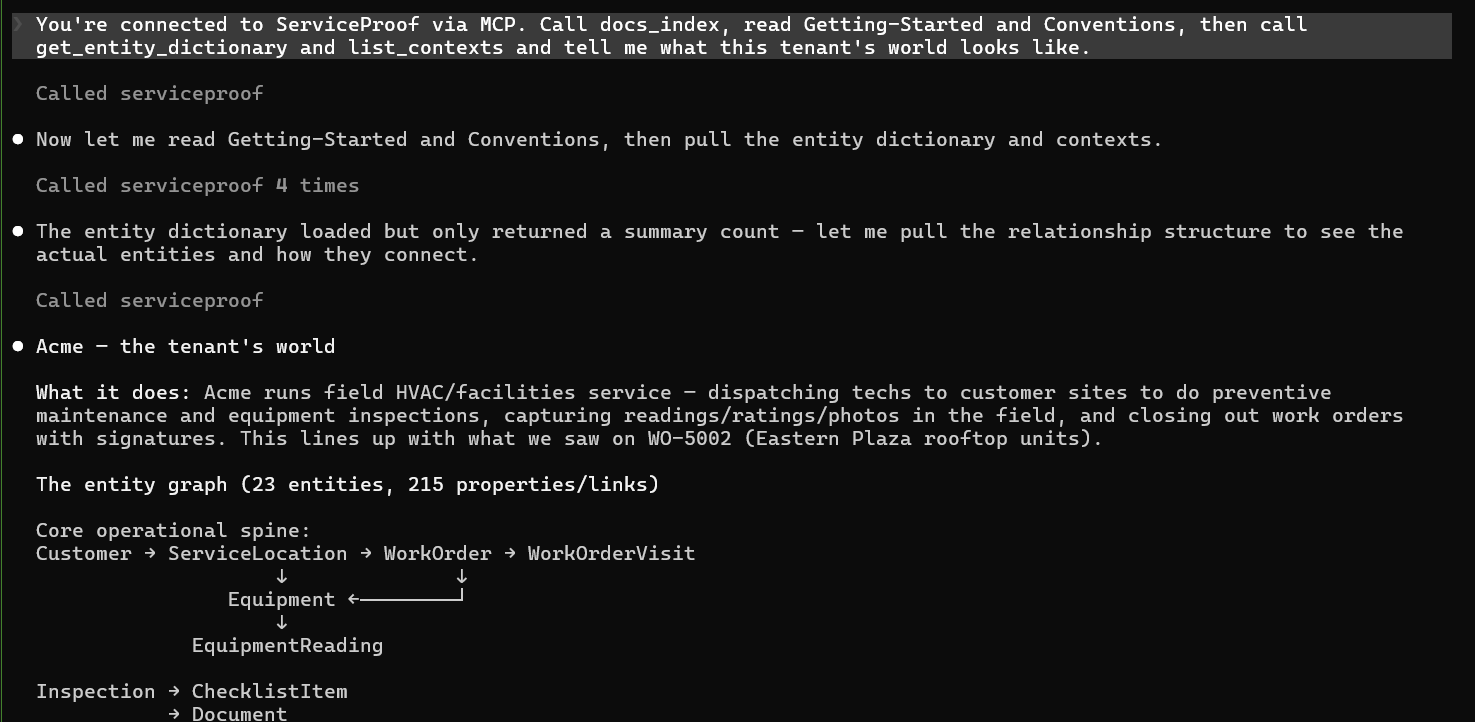
How your data links to itself — customer, site, asset, work order. You decide what hangs off what, and every token, workflow and AI reads that same world.
Your crew won't fight it
Rigid workflows fail in the field for one reason: real work does not happen in the order somebody typed it. So ours don't insist. A tech can take the paths in the order the job actually goes — our non-deterministic parallel splits, patent pending — and still cannot skip the work. They can defer a photo because the unit is behind a locked gate right now, keep moving, and get held to that debt before the job can close.
That is the difference between structure and bureaucracy. The rules are on the outcome, not on the choreography.
Watch one job get done
“Checked the condenser, 118 PSI, here's the photo.” — and the platform files a typed reading, a GPS + time stamp, the photo on the right job, and a proof PDF to the customer. Nothing retyped. Nothing missed.
That's the whole magic in one move: people just talk — and you get the exact structured data and photos you require. The ease of a conversation with the rigor of a form.
NO APP · NO LOGIN TO TEACH — onboard a whole crew, or a one-day subcontractor, with a single text.
What you could ship this month
Same platform, your data, running in the thread your crew already has open. A few of the things running today:
See the earpiece run a job › · Every feature, in plain English ›
What you get back
The ease of a conversation with the rigor of a form. Your crew describes the job out loud; you get complete, required, queryable records — and the photos that meet your obligations. That's the difference between an AI that chats and a platform that runs your business.
Your jobs, run your way
Whatever your vertical, the problem is the same: human activity you can't see and can't standardize. ServiceProof orchestrates it — the same steps, the same photos, the same proof on every job, every crew, every day — human activity captured as structured data, over rich messaging: the tools everyone already has and already knows how to use.
One published process for the whole field — nobody skips the nameplate photo again.
Every tap, photo, and spoken answer lands typed, timestamped, GPS-stamped, queryable.
It rides the messaging apps your people already live in — zero training day.
An HVAC truck, a fire & life safety round, a facilities sub — same engine, your rules.
We know what the job is really like
Workflows techs actually love — in the thread, in the ear, phone in the pocket — is why the data exists at all. Four visits, two techs, every reading captured. So when it's time to quote that customer's PM contract, you quote it from empirical data — real visits, real service history, real performance numbers your techs captured on site. Not a guess. Who else can do that?
This is what you get when you do business over business messaging.
How it works
AI chat is fluid and forgettable. We're the opposite — we start from your data and end with proof. Four moves:
Your data becomes entities and properties — each carrying its essence: a plain-language note on what it means and what it's for. So the platform, and the AI, understand your business — not just store it.
Every step is context-aware — it knows the customer, the equipment, the job — and adapts to your data. Parallel paths, branching, loops: real process, not a flat form.
A rich, tappable conversation over RCS, Apple Messages for Business, or WhatsApp. No app to install, nothing to teach — even for subcontractors.
The payoff: people just talk naturally, and we capture it into the exact structured data and photos you require. Conversational to do; structured to keep.
Go deeper
Snapshots become variances; variances become trends. Quote the PM contract from empirical field data — not a guess.
One envelope renders natively on RCS, Apple Messages, and WhatsApp — with the AI Party Line riding the same thread.
AutoDispatch, webhooks, AI insights, scheduled report pushes — install a pack, set it, flip the switch.
Hands full? Just talk.
Phone in your pocket, both hands on the work: Wingman reads the job into your ear and captures your spoken answers — still the same rich-messaging run underneath, still the same structured data at the end.
It's a breakthrough for field crews — and for blind and low-vision workers, who can now run the very same workflows entirely by voice. Smart glasses are coming next.
“Hey Wingman” starts the run; “over” sends the answer. Eyes on the equipment.
One rambling description fills step after step — validated exactly like a typed reply.
“You owe me one photo of the blower motor” — the run won't close until it's captured.
The whole workflow, by voice — independence for blind and low-vision techs.
Things you cannot do anywhere else
A list where the tech taps several items and the thread keeps the tally — the difference between a note to self and a line on the invoice. As far as we know, a first on the channel.
Write the step once. It becomes RCS rich cards, Apple Messages for Business, WhatsApp interactive, or plain SMS — each in that channel's own native shape, not a lowest-common-denominator blob.
Patent pending. Parallel paths a person can take in any order, with the work still guaranteed — because reality does not run top-to-bottom.
Who runs on this
National facility management, national and regional contractors, large local contractors. We support the field — and we speak to each.
Run your crews on one consistent process and get proof on every job. Keep your phone in your pocket and do your paperwork in your ear — the game-changer for the trades.
Extend one operating standard to every contractor on the program — with nothing for them to install. Verify the work with photo, carrier-validated GPS and a vendor scorecard, at national scale. Your subs never pay.
You do not have an IT department and you are not buying one. Sync the jobs out of the system you already run, hand your techs an earpiece, and start collecting exactly what each customer demands — without changing how you dispatch.
We already know how your business runs
Your data stays where it is
Rich messaging is only as good as the data behind it. Sync from the systems of record you already run, or drop in a spreadsheet — we enrich it, act on it in the field, and hand the results back. Start shallow with a job number and a webhook; go deep with near-real-time two-way sync. New connectors and partnerships land every week.
Integrations · works with
Storage · bring your own
Your systems stay in charge. We're deliberately not your source of truth — data flows like a river: synced in, enriched in the field, handed back. ERP-optional: the floor is a job number in and a proof PDF out.
What your ERP never gave you
Every record keeps its history automatically. Snapshots capture the changes; changes become variances; variances become trends you — and your AI — can actually see. Breakdown frequency by unit. Temperature drift by site. Agreement rates by crew. Just by being connected.
Now layer on the field: four visits to one site by two different techs isn't paperwork — it's a dataset. Human activity becomes datapoints you gather and apply — spot the trend, tighten the quote, improve the flow, even fill a vendor's PDF form automatically on every job.
Any record, as it looked at any moment — even things since deleted. Month-end close, on demand.
What changed, when, by whom — per record or replayed across a whole report at monthly snapshots.
Views and Reports trend it, chart it, email it — right in the platform, with the AI Copilot setting it up for you.
A key and a few clicks — we answer like a Microsoft SQL Server. No driver, no export step, no lessons.
You keep your system of record
Your data already lives somewhere, and it is not moving. So we sync in only what a job actually needs — from your business system, your Verizon fleet feed, the inventory platform that knows truck stock, a SQL or Postgres database, a spreadsheet somebody maintains by hand. We genuinely do not care where it comes from. You build Contexts on top to link it the way your business actually thinks about it, not the way six vendors happened to model it.
Then the field enriches it — and it goes home. An API call, a stored procedure, a webhook, or a sync straight back into the source. Whatever is safe for that system. And because we synced real keys against real context, it lines up: your record, extended, not a parallel copy you have to reconcile forever.
Sync wizards for more platforms all the time — and if yours isn't there, we will build the connector to your ERP, FSM or custom database free to get you started. Within reason, but we mean it. We like syncing data in.
Every sync captures snapshots and changes. You did nothing extra, and you now have history, trend lines and AI insight over data that used to be a single current value in somebody else's database.
Power BI connects natively. Add us as a linked SQL Server — on-prem if that is where you run, cloud if that is where you run. PostgreSQL compatible too. Your BI tools cannot tell the difference.
When the script runs out
Real conversations go sideways, and a system that can only follow its own script fails the moment somebody asks something reasonable. So any step can open the door: ASK puts one real question to a human and waits for the answer; CONVERSE hands the thread to an AI for as long as it is useful, then brings it back. Both are armed per step, and both are governed by what that step knows — the context, the essence, the data already collected.
Your field becomes your trigger
Every automation platform you have used fires on a system event: a row was added, a form was submitted, an email arrived. Useful — and always one step removed from the work, waiting for some other piece of software to notice something first.
We fire on human activity. A tech taps arrived. A customer picks two items off a carousel. A photo lands. A signature is captured. A reading comes back outside tolerance. A job is genuinely finished. Each one is an event the instant it happens — and it is not a raw log line, it is validated and structured, carrying the context with it: which customer, which site, which asset, which job, which person.
Zapier waits for your software to do something. We wait for your people to do something — and then we tell your software.
Fire a webhook. Call your API. Run the stored procedure that is safe to run. Start the next workflow. Page a human. Hand the thread to an AI and let it carry on. Because the workflow defined what done means, the trigger is worth trusting: not “somebody typed something,” but this step completed and passed validation. That is the difference between an automation that fires and an automation you would let touch your ERP.
How a job actually finishes
So workflows travel in kits — the set of things that must be true for a job to count as done. A PM visit is a kit. An install is a kit. Onboarding a new customer is a kit. Dispatch a kit against a real record and every workflow in it inherits that anchor, that context, and that person — then the whole thing is tracked to completion, in one thread, on one phone.
Who is Listrak?
Customers don't see channels. They see your brand.
Listrak connects behavior across sessions, devices, and interactions to build a unified understanding of every individual. Identity resolution stitches together browsing activity, purchases, and engagement into a continuously evolving customer profile — and real-time signals keep personalization accurate across every channel and experience.
ServiceProof is the work-and-business side of that story — and field orchestration for the trades — national facility management, national and regional contractors, and large local contractors alike.
Listrak is the cross-channel personalization platform — Email, SMS, Push, Web, In-Store, and emerging channels like RCS, from a single platform. ServiceProof extends that to work: you don't just reach people in the thread anymore — you do real business there.
One platform. One conversation. Real business, everywhere.
Start free
Start a free trial and run one real job end to end this afternoon — your customer, your trade, your close-out requirements. No card, no install. And when you're ready to go live, we set you up as a verified sender on the real networks — then you launch for real.